Going to Egypt without seeing the pyramids is like eating without a staple food.
Landing at Giza airport was the closest I’ve ever been to the pyramids. The pyramids of Egypt are in Cairo, more specifically, in the Giza district of Cairo.
Before I could feel the blazing sunshine of Africa and see the appearance of the airport clearly, a group of drivers gathered around to ask if they needed a taxi.
Rejecting the annoying routine, I walked all the way into the dry air of this strange country. The first time I saw the pyramids, I was in a local minivan.
Because of the narrow seat, the 50-liter backpack has been carried behind my back, and it has not been put down for dozens of minutes. But when I turned my head, a tiny triangle appeared outside the window-“Pyramid!” I couldn’t help but exclaim.
Is such a small one a pyramid?
It wasn’t until I got closer that I realized how big it was.
Visitors entering the pyramid scenic spot can choose to visit the inside of the pyramid. The air circulation inside is slow and unusually stuffy, so not all travelers will choose to go inside.
There are several different entrances to the pyramid scenic area. The minibus took us to one of them, found that the direction was wrong, and the driver started the car again and went on.
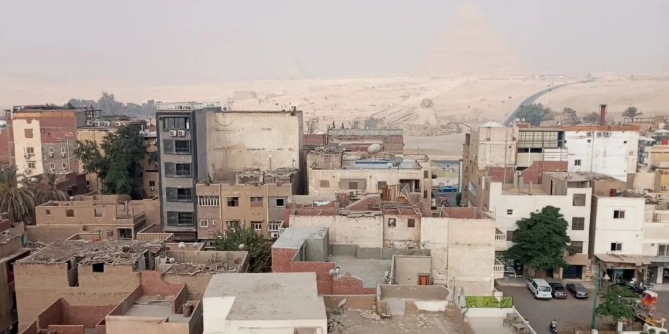
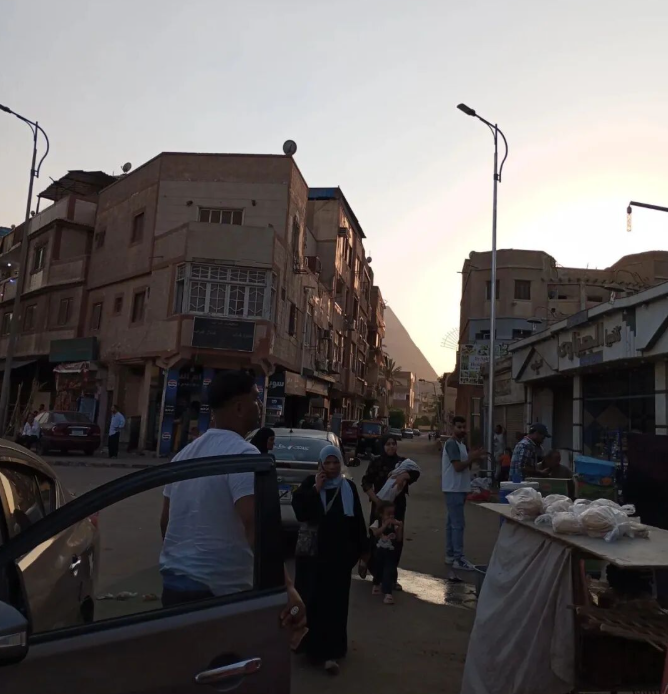
The scene in Giza is quite different from that in downtown Cairo. Many houses are in the color of earth, and once you leave the scenic area of the pyramid, you can see more real appearance.
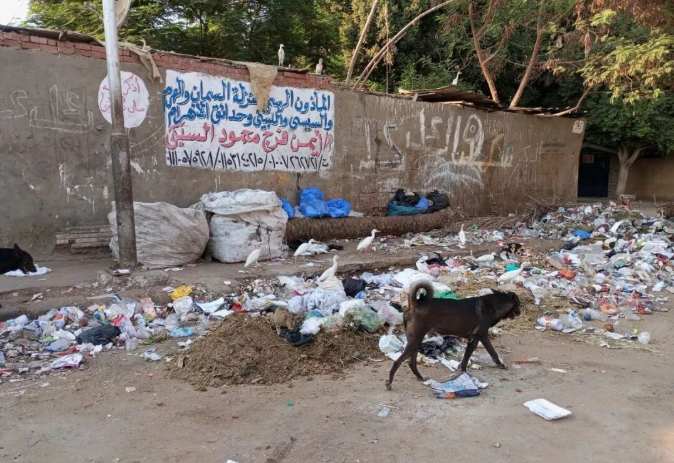
Collapsed houses become rubble piled up on both sides of the alley between buildings. If you are not careful, you will step on the feces of cows and horses, and cats and dogs will look for food in the garbage dumps.
The hotel I stayed at was near the entrance to the pyramid. When I went to the rooftop to dry clothes, I turned around and saw the pyramid again-small and far away.
When you actually stand in front of the pyramid, you will feel small. You need to look up to see the top of it, and a person’s height can’t even compare to a few stones of the pyramid.
People take photos of stunning scenery with long and short focus lenses, or funny or exaggerated moments, all of which are frozen into memories and become photo angles that tourists are rushing to imitate.
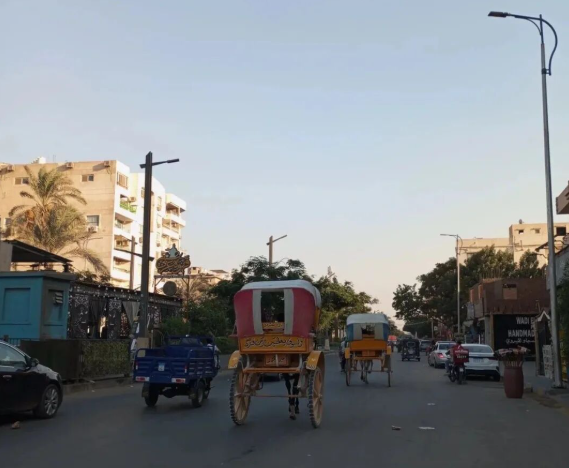
Put down my luggage to look for food. Within a few steps, I saw a child riding a tall horse passing by. The carriage walked slowly down the road, and the sun-baked dirt mixed with the scent of animals.
Giza is dominated by pyramids and museums, and these scenic spots are concentrated in one area. The small shops nearby charged a lot of prices, so I simply went to Carrefour to find food.
People who travel long distances have a basic understanding of prices, and supermarkets are the place to find this baseline. For example, the price of a bottle of water in a scenic spot may be quite different from that in a supermarket.
The price of supermarkets is the baseline for future bargaining, and it is also the simplest and fastest way to know local prices.
I needed change after shopping, and the supermarket cashier apologetically told me that there was only change in the denomination of 5 Egyptian pounds.
A paper note was exchanged for a pile of coins, and I stood by counting the money and recognizing the new currency unit. Later, when I went to other supermarkets in the city center, they would automatically erase zeros. I never got so many coins again.
It’s sunny during the day in Africa, but it’s cooler in the evening. Walk back to the pyramid from the supermarket, which is the way back to the hotel.
Walking through countless alleys, you can sometimes get lost, but you can always find your way when you see the pyramids standing there.
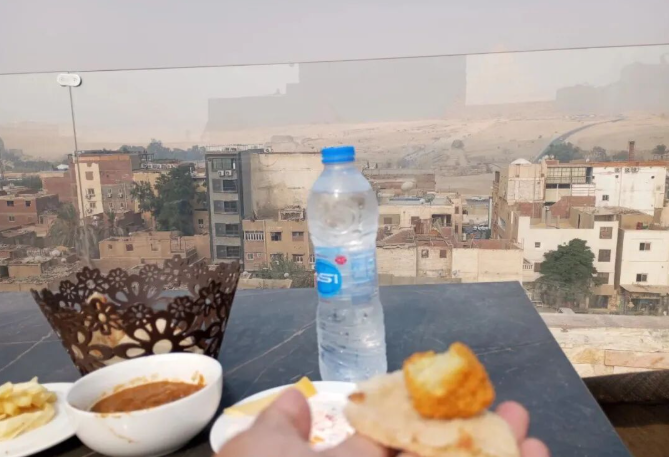
There are several pyramids of Khufu, but the Sphinx only faces in one direction. The top floor of the hotel faces it.
While eating breakfast, I took photos of the pyramids in the distance, using Egyptian food I tried for the first time, and taking photos with human faces.
Looking out at the pyramid scenic spot from a distance, you can see that the road conditions inside are quite good. During the tour bus, it’s like a model car moving.
Looking at the nearby alleys and ground, there is always a sense of fragmentation.
The scenic spot is the scenery seen by tourists, but the locals live outside the scenery.
At noon when I passed by the carriage, the pyramid I saw was alive. It mobilized all my senses-while watching it, I also smelled the heavy breath of years.
Walking out of that alley is an entrance to the pyramid scenic spot. Many people queue up to occupy the roadside, and traffic police keep order. Everything is orderly, which looks like a world-class scenic spot.
Life across a few alleys from the pyramids is a more real history than the pyramids.
If the pyramids are the business cards of Egyptian tourism, then the life inside and outside these alleys is the contact information on the business cards-only by getting through it can you know more details.
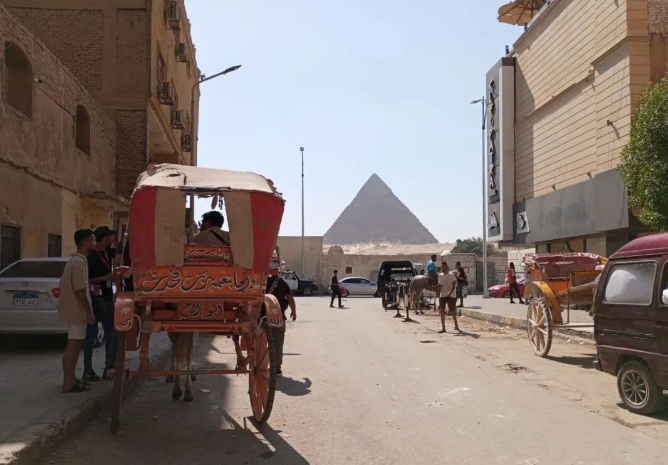
Everyone has seen the pyramids, and those who travel to Egypt are even less likely to miss it. But life under the pyramids is different from the carefully carved appearance of history.
What is impressive is not the pyramids themselves, but the wonders of those piled stones, a legendary epic that no one can fully interpret.
No one elaborates on the vivid moment under the pyramid. This is a pyramid that tourists rarely see-a scenery on par with a world-class scenic spot, a living reality, and all your encounters at that moment.
Maybe the alleys near the pyramids are not worth hanging around, but who can deny that this is not the real Egypt?
It is the truth that many tourists have never visited, and it is also the other side that many tourists have never seen.
Egypt will always be there no matter what people say about it.