Skip to Content
The journey in Egypt can be divided into distinct pre-and post-stages. The first half was quite hard, looking for public transportation all day, and the language barrier was inconvenient to communicate, but it failed to shake my determination to save money. By the second half, things began to change.
Along the way, I met all kinds of drivers, both good and unpleasant experiences, which should be regarded as a special record.
The most common places to encounter drivers during travel tend to be airports-in Egypt, some airports don’t have public transportation at all, and you have no choice but to take a taxi.
Of course, online car-hailing is also one of the options. Egypt can use Uber and inDrive. Although Didi can be used, there are not many users.
There is a subtle antagonistic relationship between Egypt’s network car and traditional taxis, similar to that in China.
At Aswan Airport, taxis almost monopolize the surrounding business. Network car drivers want to take orders but dare not enter the taxi driver’s “site”, and usually ask passengers to walk a certain distance before getting on the bus.
Because of this, taxi drivers are more emboldened to tell tourists: “There are only taxis here, so you can only take a taxi and leave.”
However, these drivers often ask sky-high prices, and it is difficult to talk about reasonable prices. When you don’t want to pester and wave your hand and refuse, your refusal is often ineffective-drivers want to make this business so much that they will communicate with you constantly and repeatedly, trying to get you in their car.
In Hurghada, on the Red Sea, I had wanted to take a bus to the supermarket. I finally called a van-this kind of bus is a mini-bus in the local area, with convenient lines and frequent flights.
After some communication with the driver and passengers, they let me on the bus. It didn’t take long for all the other passengers to get out and I started to feel that something was wrong.
Sure enough, it didn’t take long for the driver to tell us the price to go to the supermarket-$10 or $20 I can’t remember, but that distance was no more than 3 km.
Even at home, the 3 km fare is less than $10, let alone in Egypt, where the exchange rate is favorable to us.
Not wanting to haggle with him at all, I got off after paying the normal fare of the minivan.
Later, on the way back to the youth hostel from the supermarket, another driver said halfway through the drive that the navigation suddenly broke down, and he needed to pay extra money if he wanted to continue driving.
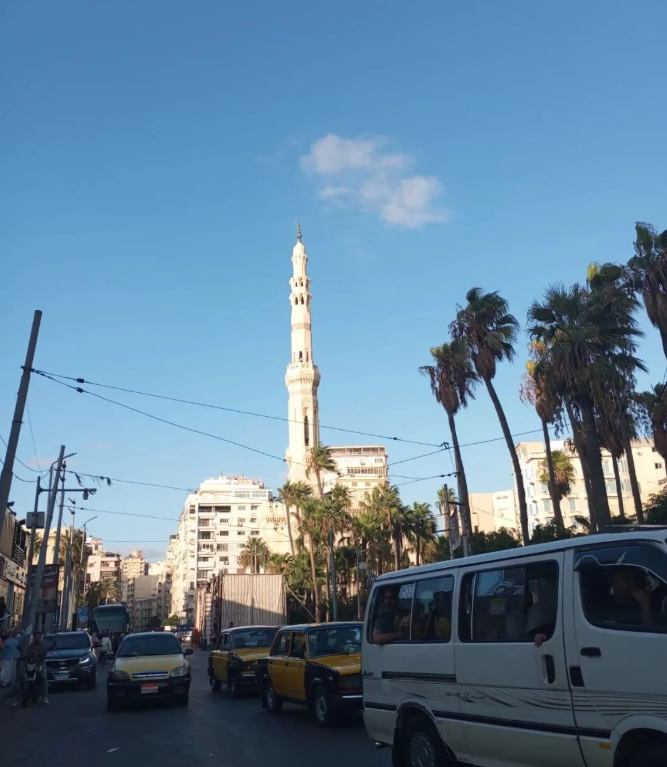
The moment he parked, there happened to be a lighted mosque outside the window, and we all picked up our mobile phones to take pictures.
How can the navigation suddenly break? The traveling companion said that he just saw him secretly fiddling with his mobile phone, and I wonder if it had anything to do with it.
The fare is completely different from the price displayed by the taxi software and several times higher. No one wants to suffer this loss.
After getting off the bus, a young driver took a new taxi, playing soft music along the way, and finally sent us to our destination without saying a word.
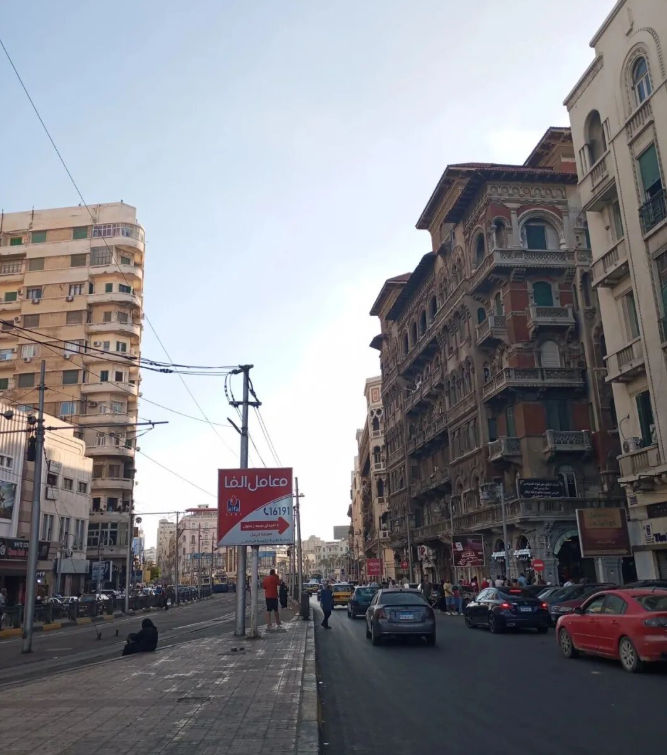
An old grandfather in the suburbs of Alexandria took us nearly an hour from the remote homestay the night before to the hotel in the city center, and he didn’t have any extra words.
The fare that day, as I remember, was only about $6-$7, while the drive was close to an hour.
From Tahrir Square in Cairo to the international airport, the taxi-hailing software shows about 6-7 USD. When he arrived at the airport, the driver had no change. He took the $10 bill but only recovered about $1.
Compared with Alexander’s grandfather, the driver’s “normality” seems less normal again.
Others clearly said the price before getting on the bus, but after getting off the bus, they suddenly changed their mouth and asked for several times. They also took the money we gave and looked innocent, as if he was being treated badly.
I have to say that Egypt has a blue and beautiful sea. How blue the sea is, how unpredictable people’s hearts are.
Just before, the driver was proudly telling the story of his hometown to foreign tourists, proud of his national identity.
Human nature is complex. The drivers I met were good and bad, perhaps different from the real appearance of their lives, but this short glimpse was enough to make people see the disparities of human nature.
Some say it’s because of the local economic situation and they just want to make a little more money.
Admittedly, this may be a reason, and it makes sense from their standpoint.
You can also encounter bad drivers when traveling in other countries, just not as frequently. Don’t drivers in those countries want to make money?
Using the economy as an excuse to renege on one’s word, either the bottom line can float, or it is too naive to kindly interpret everyone with one’s own understanding.
The story of travel is not a model house in the sales office, it is not so flawless, nor is it glamorous for others to see.
Perhaps meaningless, which is the whole meaning of it. It’s like life has come to an end. What is the end?
However, this life is still worth cherishing, even if it is a separation in the end.
Travel is just to see the world and see different people and stories.
In this way, this trip to Egypt can be said to be an experience to broaden one’s horizons, and the ups and downs of several hundred dollars are worth it.